


The Seveso Dioxin Disaster
- Mariam Tilmo
- Oct 8, 2024
- 4 min read
Updated: Oct 11, 2024


An Italian Carabinieri worker placing a sign that says “Access prohibited to all non-authorized persons” in an affected area. (Image courtesy of Extra Per Voi)
Introduction
In the three decades since Italy abandoned its pro-WII fascist regime spearheaded by the dictator Benito Mussolini, the country sought major social and political reform. The New Republic of Italy reaped the benefits of having joined the Allies during the conflict: its post-war reconstruction program of 1945-47 was spurred on by aid from President Truman’s Marshall Plan, and Italy soon became a chief player in the exploration for oil in the Middle East due to geographical proximity; low taxation, weak worker unions and cheap labor from the rural countryside appealed immensely to foreign investors and incentivised the building of industrial factories. An economic boom soon ensued, with industrial growth rates topping 8% per annum; Italy’s northwestern triangle largely contributed to sectors such as textiles, plastics, artificial fibers, car brands such as Lamborghini and Maserati, and furniture manufacturing.
Situated north of Milan, the small town of Seveso was exempt from this rapid industrialisation: yet it would soon experience one of the worst industrial accidents of the 20th century at the hands of corporate greed. The Seveso Dioxin Disaster of 1976 is often likened to the incidents of the Chernobyl Incident (1986) and the Bhopal Accident (1984) for its extensive damages to the environment, people and livestock that are being witnessed to this day.
A Poisoned Summer
2,3,7,8-tetrachlorodibenzodioxin or TCDD is a by-product of common industrial processes like paper bleaching and garbage incineration. Dioxins are recognised in the scientific community as harmful carcinogens- substances capable of causing cancer to living organisms. They were used by the US army during the Vietnam War in the form of Agent Orange, a herbicide that destroyed approximately 500,000 acres of crops; its large dioxin presence continues to cause birth defects in Vietnamese babies as it is a persistent organic pollutant.
Nearby the town of otherwise rural Seveso was a chemical factory owned by Industrie Chimiche Meda Societa Azionaria (ICMESA), whose subsidiary was the Swiss-based Hoffmann-La Roche, a pharmaceutical giant during the 1960s and 70s. The plant itself focused on the production of 2,4,5,-trichlorophenol, a chemical substance found in the makeup and pharmaceuticals sold by its parent company, Hoffman-La Roche.

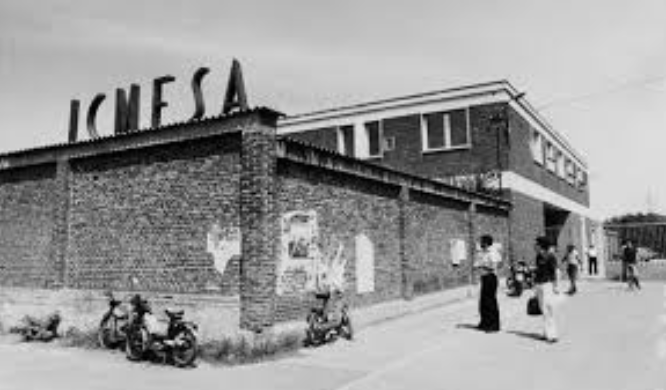
The ICMESA factory, owned by Hoffman-La Roche, manufactured TCDD for pharmaceutical products. (Image curtesy of the Environmental Justice Atlas)
The factory building had not undergone major inspection although it had been built decades prior, with most deeming it not to be a threat. On the 10th of July 1976, a batch of TCDD was stopped just before the final step had been completed (using distillation to remove ethylene glycol from the mixture), as Italian law mandated that all operations stop for that weekend. Since other parts of the factory had already begun to slow down, a massive drop in the central power supply resulted in the wind turbine to slow and the steam exhaust’s temperature to increase to 300 degrees, surpassing a 230 degree cap. With the factory workers not having access to a temperature reading, they remained unaware of the fact that the steam was slowly heating up the walls of the reactor, in turn heating up the mixture inside way past its boiling point. The employees then paused to turn off the reactor’s stirrer, the one thing that kept the heat from becoming concentrated to the upper walls of the reactor. This lead to an exothermic reaction that released even more heat and began a 7-hour process of a runaway (unplanned) reaction.
Later that day at 12.37 PM, 6 tons of chemical products including 15 to 30 kilograms of the extremely toxic TCDD dioxin, sodium hydroxide (a severe irritant to the eyes and lungs) and ethylene glycol (a poison), were released in the form of a thick, white cloud instantly. More than 37,000 civilians on their way to school and work were immediately compromised: about 500 residents were hospitalised for skin irritation, 19 children left with skin lesions and 193 developed chloracne (a condition characterised by cysts, pustules and painful blackheads). Towards the end of the month, 3,300 animals, particularly rabbits and chickens, were found dead due to dioxin exposure. At the end of the 1970s, about 80,000 livestock, including cows and sheep, would be mass slaughtered to keep dioxin out of the food chain and prevent further contamination.
Aftermath
Governmental action towards safeguarding civilians has been criticised for being slow and ineffective: due to the slow effects of dioxin, it took days for civilians to start falling sick. Initially, ICMESA did not admit to the accident; it took a week for a public statement to be issued, stating that dioxin had been the released chemical, and 2 weeks for an investigation to ensue. The factory’s overall lack of safety precautions, including a temperature reading, central warning system or government-enforced health and safety protocols for the town’s inhabitants, led to confusion and further destruction on the lives of the townspeople, animals and environment.
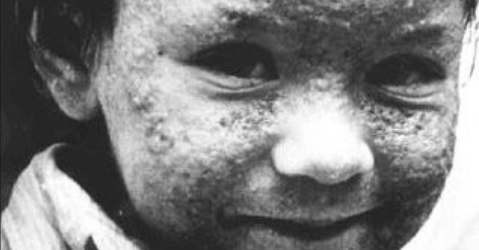
Children were especially affected, with victims experiencing intense chloracne, a severe form of acne. (Image courtesy of Accidents Oil and Gas)
In 1982, the European Economic Community (which soon became the European Union), passed the Seveso Directive that called to attention the importance of imposing strict safety measures in places where toxic chemicals are managed to prevent extensive impact on workers, local people, animals and the environment in the case of an accident. The Seveso Directive applies to all 27 countries within the EU, and is called the COMAH Regulations in the United Kingdom. The area in which the factory once stood has now turned into a public park named Seveso Oak Forest Park. The ruined buildings, toxic soil and animal remnants are enclosed in a concrete sarcophagus that is expected to last 300 years, which will hopefully be long enough for the dioxin to break down and give way to a healthy ecosystem once more.
References
Leah Temper, Daniela del Bene and Joan Martinez-Alier. 2015. Mapping the frontiers and front lines of global environmental justice: the EJAtlas. Journal of Political Ecology 22: 255-278. https://journals.librarypublishing.arizona.edu/jpe/article/id/1932/
"Seveso chemical disaster" (Environment & Society Portal - https://www.environmentandsociety.org/tools/keywords/seveso-chemical-disaster)
"The Seveso accident: A look at 40 years of health research and beyond." by Eskenazi, Brenda et al. (https://www.ncbi.nlm.nih.gov/pmc/articles/PMC6221983/)
"The Seveso studies on early and long-term effects of dioxin exposure: a review." by Bertazzi, P A et al. (https://www.ncbi.nlm.nih.gov/pmc/articles/PMC1533388/)
